small business AI tools

A customer complaint shouldn’t be your first warning that your custom AI broke. This guide shows you how to run a lightweight, hands-on evaluation loop for your custom AI workflow agent for small business without needing a data function. You will learn to design risk-aligned rubrics, establish 20 to 30 representative test cases, and combine deterministic checks with LLM judges to safely gate releases.

When AI workflows are poorly designed, businesses end up paying for them twice: once to the vendor in API tokens, and once to staff who spend hours reviewing and correcting errors. This guide reveals how to achieve reliable AI automation by moving away from overloaded, model-centric steps. You will learn to construct a staged pipeline—separating extraction, classification, verification, and execution—so your automated systems run predictably, cost a fraction of the price, and require fewer human interventions.
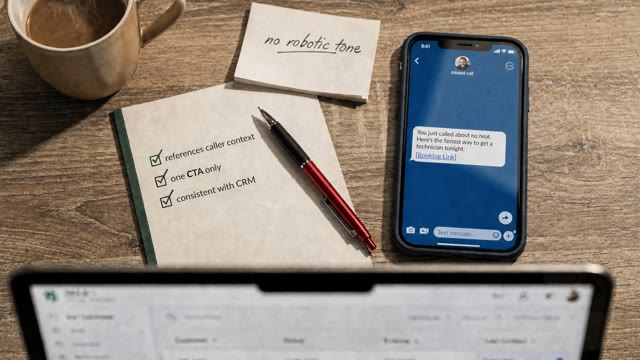
A standard text-back script can feel incredibly robotic and drive potential customers away. This guide shows you how to optimize an AI receptionist for small business by writing natural, high-converting follow-up texts. You will learn to apply the 'Role + Context + Constraints' prompt framework, anchor every SMS to a live trigger, and run a measurable QA loop to recover missed-call revenue with ease.

Choosing between an AI receptionist and a human virtual assistant is about more than just conversation. This post introduces a decision framework to compare AI automation services for small business based on call complexity, speed, and cost. You will learn how to design a high-converting hybrid model, establish clear human escalation triggers, and maintain complete auditability over multiple voice agents to recover lost leads without sacrificing quality.

Many business owners view an AI receptionist simply as a call-answering tool, but its real value lies in plugging hidden operational leaks. This practical guide breaks down the five critical places where your business quietly loses money, from unstaffed after-hours coverage to fragmented channels. Learn how instant response safeguards your booking calendar and why tracking your own numbers replaces expensive vendor guesswork.

Voicemail is where trades and home service business leads go to die. This practical guide shows you how to deploy an ai receptionist to recover lost leads by capturing missed calls instantly using automated SMS and voice options. You will discover realistic conversion benchmarks, understand what CRM and calendar integrations actually require, and build a reliable hybrid setup with clear human escalation rules.

Uncontrolled software buying often drains your company margins without actually boosting worker output. This practical guide shows you how to calculate real return on investment using a direct formula for small business AI automation. You will discover how to isolate key operational metrics, map specific models like Claude or ChatGPT to distinct workflow steps, and permanently eliminate wasted business subscription spend.

Running a profitable company means watching every expense, including software. High AI bills are rarely caused by expensive vendors, but rather by routing routine tasks to premium models. This guide to small business AI automation explains how to stop over-processing simple tasks and establish a tiered routing system. We cover actionable cost controls like caching and output limits designed to stop runaway costs and protect your profit margins.

Deploying AI agents for business can dramatically accelerate your workflows, but unchecked software autonomy risks critical system failure. In this practical guide, business owners will learn how to identify dangerous automation drift, configure robust technical kill switches, and set clear rollback rules. Stop costly mistakes before they reach your clients by establishing safe boundaries and scoping your AI implementation services correctly.

AI tool walkthroughs look great in demos, but live operations quickly expose weak system plumbing and fragile integrations. This practical guide reveals why raw small business AI automation collapses under messy real-world data and unexpected updates. You will discover exactly how to deploy robust AI integration services by establishing safety gates, versioning, rollback paths, and human-in-the-loop checkpoints that protect your brand's reputation.

Stop treating standalone chat tools like an all-in-one solution. This operational guide explains how to build a resilient small business AI strategy that preserves context, eliminates costly tool sprawl, and coordinates a highly secure, multi-tool AI workflow. By establishing clear workflow-first decision rules and active human review baselines, your business can finally achieve repeatable, high-quality outcomes and protect sensitive client data from leaks.

Skipping straight to complex AI agents often leads to operational sprawl and wasted software budgets. In this post, you will discover why your business's AI maturity must follow your actual process maturity to succeed. Learn to climb the adoption ladder step-by-step—from simple FAQs and copilots to secure workflow automation—using a practical 90-day pilot framework designed to protect your team's productivity and client trust.
Every other Tuesday, The Human Factor takes one psychological principle, drops it into a real moment in a small business, and shows what an automation does about it. Three minutes to read. No tutorials, no jargon, no AI hype. Just the reason your intake form never gets finished or your best customer goes quiet after a price change, and a fix you could have running in a day.
The moment — A real scene from a small business: who's in it, what they're trying to do, and what they do instead
Why it goes wrong — The psychology behind it in plain terms, explained through the moment rather than the textbook. One principle per issue
What the automation does — The fix, laid out as a simple flow, and what actually changed in hours or dollars